mbti: (Default)
The auxiliary function is always, always values. They value whatever is in their aux position, whether it is endless possibilities (Ne), being productive (Se), quantitative reliance (Si), what now means for later (Ni), making goals and executing them (Te), impacting others (Fe), the self's inner values and wants (Fi), or internally followed logic (Ti.)

Before you type a character a certain way, examine what their auxiliary function may be - does their auxiliary function seem to be important to them? Or is it simply used, like a dominant or tertiary function?
mbti: (Default)
Regardless of the internet's overall frequent misinterpretations of MBTI (I blame the elementary way it's often summarized; I'm much more into socionics theory than academic MBTI theory due to that socionics tends to flesh things out more and measures people's functions based on interrelations and behavior wrt cognition), graphs like these actually highlight the usage of functions well:
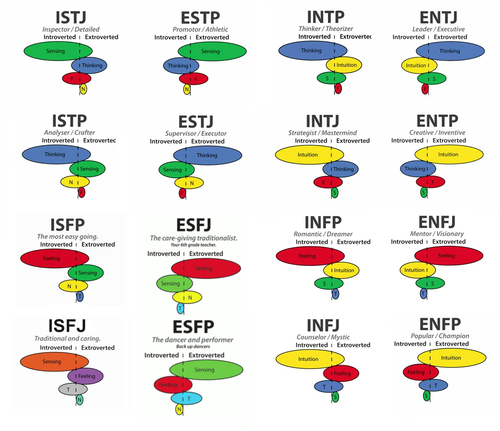


Whenever I type people/characters/whatsoever, I usually keep an eye out for dominant and tertiary functions. This image implies - but doesn't state - and I've also seen here and there, that the dominant and tertiary functions tend to be the most prominent in behavior. When I was first learning about cognitive functions, I'd read that the dominant function is the thing you use the most naturally, without question; the tertiary function is what you use without question, but not as naturally.

It's interesting, and paves a way to my theory of this:
(which I've also seen implied here and there among abstract posts about cognitive functions)

Dominant and tertiary functions are what you do. Auxiliary and inferior functions are why you do them.

Obviously I don't mean this literally; but it's more in that while you "externally" use either your dominant or tertiary function, your internal procedure is more keyed on the auxiliary and/or inferior function.

ExxJ vs IxxJ, and tertiary functions


When it comes to typing, this is why I tend to seek the tertiary function, or at least have a couple of contenders. (Usually I can distinguish the functions that are either dominant or tertiary; it's positioning that sometimes takes me a while.) I have seen typings of characters that I find to be obvious IxTJs as ExTJs, possibly because of the aggression of a Te. But in the case of STJs the characters I find to be "obvious" ISTJs do not have tertiary Ne at all, because their Ne is something that they reject, or are hard to consolidate with, or only come during moments of panic - inferior at worst.

As for INTJs vs ENTJs, I think it's really a matter of taking into consideration that since INTJs have Te auxiliary, it's a likelihood that in instances they are militant and emotionless, it's completely deliberate, whereas for an ENTJ it would just seem more "natural," as in the idea of them being otherwise is bizarre and unnatural to them. Contrary to popular belief, INTJs have more flavor in this area, both in this choice to exercise their auxiliary Te in an intentional way, and also the tertiary Fi. People often talk about INTJs like they've forgotten that the INTJ's instinctive yet unnatural function is introverted feeling. But we'll get to tertiary functions in any introvert later.

I find there to be similar issues between the I/E dichotomy with NFJs. (Hilariously enough, most people can at least distinguish an ISFJ from an ESFJ.) I have seen many characters/people - usually women, mind you - typed as ENFJs, when I would highly oppose the idea that the person in question has inferior Ti. It's because the thing about IxFJs is similar to that of IxTJs - their aggression or friendliness or whatever that may make them seem like their extroverted counterpart (i.e. leading with Fe or Te) when it's really not that simple. With an ExFJ, the constant awareness of others and how one's (or other's) behaviors affects others is, like the ExTJ, a natural mode. To think or behave otherwise is foreign concept to the ExFJ.

The IxFJ, like the IxTJ, is deliberately friendly, or concerned about others, or what have you. They do not behave friendly and invested in others because it's their natural way of thinking, but because it's highly important to them. When interacting with an IxFJ, you get a stronger sense of how much they do (or don't) care about how others live their lives and interact with each other - plus, with that tertiary Ti, they're also awfully good at justifying whatever they say due to this. On the other hand, when interacting with an ExFJ, comparatively you get a stronger sense of how externally aware they are - usually external social awareness - more than anything else. Of course, this doesn't mean "socially competent" (although the average ExFJ is likely to have the most socially competent people), but the mere aspect of focusing outwardly, judging first by any ethical implications around them.

ExTP and ExFP, and tertiary/auxiliary judging functions


When it comes to ExTPs and ExFPs, it can often be tricky in choosing whether they're one or the other (F vs. T.) Sometimes it may feel obvious, but I think the most important thing is to compare if they're aux Ti/tert Fe, or aux Fi/tert Te. An ENTP (I would say looping, but I think an average ENTP is prone to this too) may look like an ENFP by how "random" and enthusiastic they are. However, because of an ENTP's tertiary Fe, it's likely that they're doing this on purpose - that they want to get a rise out of people, that they are desperate for attention (however buried down it may be). An ENTP is aggressive in this.

And it's not to say that ENTPs are rude and ENFPs are sensitive. It's intention. Despite the Fe doing things for/around people, because the Fe is tertiary, the ENTP struggles more with being socially aware - that is, recognizing that what they're saying/doing works, how people react to what they're doing, thinking about how what they do/say impacts others. The tertiary Fe tries extremely hard to be used, but unlike the ExFJ, the average/unhealthy tert Fe lacks the subsequent awareness in being used.

But the tertiary Fe does not come in just forms of calls of attention - it can come out through complete apathy, in which the user convinces themselves that they don't need to be concerned with how they affect others; or caretaking, in which the user tries very hard to protect and provide for people around them. Again, though they may behave these ways, the downside of any tertiary function is consequential awareness.

And like any F in any type, the tertiary Fe is highly selective and protective of those they care about.

The auxiliary Fi is different. People tend to assume that hyper, enthusiastic, random, happy, and usually loud characters are ExFPs, ENFPs more (if the character is ubiquitously happy.) And they're not always wrong.

(I will write a post on dom Se vs dom Ne at some point - that's another distinction I want to discuss.)

However, what sets the loud ExFP apart from the loud ExTP is that there is more... sincerity. (Sorry looping ExTPs.) An ExFP is behaving as such because that's themselves, they're choosing to do so because they want to. Where the obnoxious ExTP is prone to feel more performative or doesn't regularly appear to have some strong internal value driving them, the obnoxious ExFP is just Like That.

Like everyone who knows cognitive functions knows, Fi is largely based on internal self-awareness and personal values/ethics. When it comes to being in the auxiliary (or inferior) function, it is less used and more of a backdrop. What the ExFP and the ExTP have in common is that they are both aware of how they want to affect other people. However, the ExFP uses their (objective) tertiary Te to exert whatever it is they are exerting (usually activities/projects/ideas), while their auxiliary Fi a) knows how they want to affect people, and b) is aware of how they affect people, due to being in a "thinking/internal" (aux/inf) position.

It's not to say that auxiliary Fi is superior to tertiary Fe. An ExFP may be more naturally likable than an ExTP (your mileage may vary, of course; I'm just going by general overviews), but once the ExTP utilizes their Ti enough along with their Fe, they will notice patterns and make logical conclusions of how people will react and can easily navigate their way through a social atmosphere. Conversely, a looping ExFP may ignore personal values and their aux Fi will instead depend on external values/situations rather than self-generated emotions, ideas, and principles.

A looping ExFP is unique in that they tend not to look like their more average counterparts at all. Of course, I can say this about any type - but I feel like, for example, with an ISFJ, you still get some sort of idea that they are an ISFJ despite their being in an Si-Ti loop.* However, a looping ExFP tends to look extremely apathetic, indulging themselves in something they externally act on that they know will not guarantee in making them happy. This is the tertiary Te - usually a looping ExFP is overindulging in creating and performing objectives that their Fi does not genuinely and fully want without some sort of unhealthy motivation. Due to whatever is buried deep down within their auxiliary Fi - whether it's insecurity, trauma, need for attention - that is what's driving them. A looping ExFP knows exactly what they're doing! They also likely know why but try to ignore that reality. And yet, when presented with an issue, situation, or person they care about, they can easily access those emotions internally because their auxiliary Fi is still auxiliary Fi.

(I've been obsessed with the Good Place recently and there is a certain character there who I keep seeing typed as a T when I am pretty sure it is a looping auxiliary Fi.)

I dislike calling auxiliary Fi users "sensitive," although that's what they are in a more literal sense. Their static Fi both knows who they are and how what they do may impact others. An ENFP who gets into an argument knows they are, and knows they will get a rise out of the other person. An ENTP who gets into an argument is either completely unaware, or doesn't care.

So the ability to blatantly ignore that auxiliary function comes with any other type. The thing with ExFPs is that since Fi is basically self-sincerity, ignoring that tends to make them look not like themselves - that is, not like an ExFP and prone to getting mistyped. This is the issue with perhaps bizarre looking extroverts looking like another type... but not quite.

... I absolutely did not mean to make the ExFP vs ExTP portion so long, apologies.

* Loops are not void of the auxiliary function, but rather become extremely subconscious while the user struggles with their dominant & tertiary functions. Despite not being "used", from an outsider's perspective they can still be pretty visible.
mbti: (Default)
hilariously i feel a lot more familiar with noticing judging functions, but i think i've finally grasped a concept of how Ni works to make this post...

and as usual, it's all metaphor. because that's how i work i guess.

the body of water analogy
Ni = the dry path of a stream (carving, anticipatory, outlined, distinct, aiming, linear, mental guideline, acute/goal, having a method)
Se = the water in the stream (filling, being, there, action and reaction, substance, working to work, actually doing/making use [a stream is not a stream without water in it!], doing the method)
Ne = clouds above the sea (hovering, unrestrained, ambiguous, expanse, flexible in size, excitable on many fronts, constantly everywhere, moving, unpredictable, looks flimsy and senseless but is definitely there)
Si = sea below the clouds (moving with substance, intent, mysteries below the depth that it concretely knows, works at a pace that can't be easily shaken, containable but practical, moves in the space it has)

or...

the physical object (or sphere, as that is what i usually picture) analogy (not to be taken interactively)
Ni = inside the sphere
Se = the outside the sphere
so: the Ni/Se user possessions that awareness/consciousness of what they are thinking vs what they are actually doing. they are simultaneous and together and aware of each other, but bias/practice/placement in stack can also create that separation and disconnect. either way they remain conscious (neutral term; can indicate hyperawareness/overload, paranoia, or comfortable awareness) of both despite behavior; even if they withdraw "inside" they remain aware that the "outside" exists, or if they overexert/try to live most "outside," they are still aware of the hollowness or darkness or whatever other shit that is possessed on the "inside"
Ne = the sphere split into multiple other smaller objects that make it up and scattered across a space (not necessarily broken, just in pieces)
Si = the sphere as it exists: together, whole, solid as one
so: from my experience, Ne/Si users tend to feel each is a different "mode" and usually try to find the middle ground or how to use both at once. they are much more separate and motion-based and less simultaneous, as within analogy if a sphere is split up into multiple pieces it cannot exist as a whole solid sphere at the same time. essentially the Ne tries to find ways it is not the way that is expected of them - hence, though expectantly the sphere (the initially stated analogy), it is determinedly not a sphere within the analogy, while the Si exists as expected. this leads to an intensity since it can take time to take something apart, or put it together, which is why Ne/Si users often become intense in their work while not really meaning to be that intense, because subconsciously when they work their brain and body work together to focus on a single task, which also can lead to their efficiency in other areas getting impaired
(as opposed to the Ni/Se, who fall to these things more intentionally since they are aware of/need to pair the brain & body work, if also exhibit this behavior)

now i'm tempted to find legos and make a video about this lol
mbti: (Default)
The difference between Si and Se is that one is internal, one is external, thus that the internal one can change - because it's the user's understanding of how their past experiences can affect current and future ones - while the external one is grounded. Not rigid, not firm, but aware. Present. Here. Both are fundamentally concrete and things that people can physically recognize as facts, but Si is the internal recognition of what is fact while Se is the external awareness of what is fact.

Picture this:

The sea and land. Land stays solid, is itself. Land shows you everything above it, as they are. Texture of what's beneath your feet, trees and building and people. Land is obvious, presents itself as it is, makes no attempt to hide itself but instead contains an outward "here is what things are and what you can sense is all there is" with nothing hidden, nothing to figure out. It is not only surface level - surface is the only level, and it can be simple or complex but it is there.

The sea, meanwhile, moves about. The creatures in the sea are constantly swimming from different places, and there are different layers that you may or may not be able to see from the top. The sea is expansive and constantly accessible but also always moving, changing, readjusting itself but in every way still the sea. If you don't dive deep enough you'll find something; if you dive too deep you'll still find something. It contains multitudes of things that still make it the sea, but many things are still things that only the sea knows.

In the same way, Se is the land - Si is the sea. Se is aware of the physical world's inability to hide and, depending on the user, can recognize or embrace or try to adjust to that. On the other hand, Si contains vast and multitudes that are constantly being reassessed, but things that it already contains, things that come into it. Si is a constant source of information and recognition of things that have been stored or addressed, the same way the sea may seem so tumultuous surface level but everything fits beneath it anyway.

For the Se user, the Ni is a mountain.

On all the flat land, there are still mountains and hills, some hidden behind clouds, some inaccessible to climbers. These are deep, angled places where people go alone because they want to be, and mountains will only get higher. (This is not a scientific fact but bear with me here.) Mountains are high above the rest of the land and away from civilization, seeking their own aspirations away from physical presentness and ultimately achieving it, on their own.

People who main Ni live on this mountain, always looking for how high they'll go, in their minds. On their own, they keep looking and looking until they see the top, because every mountain has a top (otherwise it wouldn't be a mountain.) They like and prefer this, and are always looking for higher mountains to climb. Once in a while they will have to remember what it's like to come back down and feel the flat ground under their feet again.

On the other hand, main Se users are the ones whose feet are usually on the flat ground. They are constantly interacting with the world around them, walking and running on flat ground, seeking and finding and understanding what they can do now, the plain unhidden reality of today. It's fine, of course, but there are still hills and mountains on the ground and every once in a while they will remember that the only way for them to walk all of the land is to climb the hills, too, unexplored things that they will have to achieve themselves.

As for the Si, the Ne is the seafloor.

The thing about the ocean is that there are so many unexplored depths - scientifically there is no possible physical way for any human to explore all of the ocean floor (because of water pressure) and the things we have seen are dark and vast and full of strange things we can't even begin to dream of. I mean, it's dark and mysterious of course, but there are still things, things that could be found if we just looked. Yes, it's not explorable and far too much for us to possibly see, much less understand - but the ocean floor still exists despite what we don't know about it.

Similarly, Ne is constantly aware of the abstract unknown (although a seafloor is, well, concrete, not literally abstract.) They are constantly searching through this seafloor, uncovering whatever, no matter how dark it may be. People who main Ne do not reject things that we cannot see, that do not have any fundamental basis or proof of existence. Because at the bottom of the seafloor things do exist and the Ne user consistently discovers things and ideas that others may never get to see with their own eyes. However, those who main Ne do need to remember that they still live in the sea, and that the bottom is not its only layer; they still have to come up to the main visible sea level - the Si - and recognize and remember the things they do see and know.

So the main Si user will constantly live in this - what could be considered "bubble" or "comfort zone" but to the Si user would be recognized as what they see is necessary, which is also correct in their own way because for them, there really is no need to search the depths of the ocean when the vastness of the sea already contains the things they have already learned to recognize and know. But the seafloor - the Ne still exists, and sometimes the Si user will feel a sudden desire to explore it even if it's not what they're used to, or they will try to ignore it as deft as they can even though it's still there. Despite all the main Si user knows, there is still a darkness (not to be associated with evil of course, by the way, just ~uncovered mysteries~) at the bottom of their ocean that they will realize they are completely unfamiliar with.

the basics

Nov. 27th, 2016 02:18 am
mbti: (Default)
debunking the myths! mbti is not:
  • strictly the four letters that show up in your personality typing.
  • a gimmicky definition applicable to every person or character in existence
  • incorrect


now that we've got that out of the way.

mbti is a theory of psychology and cognitive process (not scientifically proven - hence the word "theory") based on the jungian thought that the four core functions of the brain are Sensing, Intuition, Thinking, and Feeling; with certain types of each and certain combinations of each, we result in eight functions and sixteen total basic personality types, thanks to the myers-briggs mother-daughter team.

the certain types of any core function are Introverted and Extroverted; so, two types of four functions, and then the math. every personality type has a stack of four particular functions, each function being either Sensing, Intuition, Thinking, and Feeling, with no overlap. at the same time, of these four functions, two are extroverted and two are introverted. all functions have to balance the other. every personality type leads with two particular functions; the other two are Tertiary and Inferior.

Sensing and Intuition are considered the Perception functions, as they have to do with our interaction with the seemingly impersonal: the world. on the other hand, Thinking and Feeling are the Judging functions, as they are more focused on the self, personal, and concrete. Judging/Perceiving, however, is not determined by the function that the personality leads with (their Dominant function); but rather, of their two main functions, which one is the Extroverted one. that is what decides whether a person is a Judger (if their Extroverted function is Judging) or a Perceiver (Extroverted Perceiving.)

Introverted functions are considered the "irrational" functions, as they rely on solely internal processes and humans are always flawed. thus, one Introverted Thinker's perception of "logic" will never be the same as another's, because their brain's pattern of logic differs, even if they may be the same personality type. it is not to say that Introverted functions are individually unreliable or biased, but rather that Introversion draws energy only from the self, which is heavily influenced by surroundings, background, knowledge, and pure brain processes, and cannot ever be viewed objectively: only subjectively.

on the other hand, Extroverted Functions are the "rational" ones, because they interact with the world openly. where Introverted Functions live mainly in the brain, and speaking in a vacuum, Extroversion sees the world, and objectively, and draws energy from it without prejudice.

and a brief rundown of each function:

Fi: Introverted Feeling. personal desires, feelings, and values.
Fe: Extroverted Feeling. awareness and reactive to others.
Ti: Introverted Thinking. internal logic, patterns, and analyses.
Te: Extroverted Thinking. execution, the action of ordering and structure outside the self
Si: Introverted Sensing. establishing & reactive & immediate structure in response to or in relation with concrete practicality, usually with naturalized effectiveness
Se: Extroverted Sensing. experience and action as they exist within a vacuum, external interaction with an uncontrollable world
Ni: Introverted Intuition. mental abstraction and discovery and understanding, usually in response to or relation to but divisively separate from the external world and only internally contained without necessary reason or practicality, just internal establishment
Ne: Extroverted Intuition. fascination, possibilities, ideas as they exist on their own

obviously, in different parts of the stack they'll mean different things. but that's for later posts...

Profile

mbti: (Default)
i notice the perscriptive

December 2022

S M T W T F S
    123
4567 8910
11121314151617
18192021222324
25262728293031

Syndicate

RSS Atom

Most Popular Tags

Style Credit

Expand Cut Tags

No cut tags
Page generated Jan. 22nd, 2026 07:21 am
Powered by Dreamwidth Studios