
mbti: (Default)
at least 60% of all intps are gremlins. no i will not be taking constructive criticism on this post. yes i am one of them.

in nuance

Jun. 1st, 2017 08:01 pm
mbti: (Default)
introverts: the modes that get undersold

intps can be incredibly driven and passionate
infps can be intensely knowledgeable and rational

intjs can be incredibly sociable and adaptable
infjs can be intensely bossy and determined

istjs can be incredibly sociable and passionate
isfjs can be intensely detached and rational

istps can be incredibly driven and adaptable
isfps can be intensely knowledgeable and determined

extroverts: not as simple as an outgoing framework

entps can be two sides of silly and serious
enfps can be two sides of distracted and focused

estjs can be two sides of withdrawn and outgoing
esfjs can be two sides of supportive and aggressive

estps can be two sides of relaxed and anxious
esfps can be two sides of down to earth (outspoken) and dreamy (softspoken)

entjs can be two sides of control freaks and cheerleaders
enfjs can be two sides of sensitive and unbreakable

and -isms

Apr. 2nd, 2017 04:21 pm
mbti: (Default)
no, not that kind of ism.

S-doms and T-doms are usually very expressively, visibly realistic, hence a natural need to act immediately in response to it - ExTJ, IxTP, ISxJ, ESxP
N-doms and F-doms are much less visibly focused on reality, as they tend to be wary or afraid that vocalizing an abstract fear into a concrete territory will make it real; if anything they tend appear more idealistic - IxFP, ExFJ, INxJ, ENxP

S-auxiliary and T-auxiliary to F-doms and N-doms are actually much more pessimistic than they appear, hence an innate desire to act immediately in response to it. If healthy and not in the grip this will appear as realistic idealism. - ISFP, ESFJ, INTJ, ENTP
N-auxiliary and F-auxiliary to T-doms and S-doms are actually much more optimistic than they appear, usually trusting in that their initial action (as motivated by their dominant function) to sail an abstract course away from their initial pessimism. If healthy and not in the grip this will appear as idealistic realism. - ENTJ, INTP, ISFJ, ESFP

S/T dom auxiliary and T/S dom auxiliary combine their perceived more pessimistic natures into a view they establish more objectively; that is, realism. They both act in the moment and react in the moment, able to perceive or believe in possibilities but still respond to the nature that is in front of them. If healthy and not in the grip they will have ambitions, moral values, and beliefs that they put a lot of themselves into. - ESTJ, ISTP, ISTJ, ESTP
F/N dom auxiliary and N/F dom auxiliary combine their more hopefully abstract natures into a view they establish not necessarily with optimism, but with idealism. Despite what they see is happening now, and despite what they are doing now, they have an inner faith that they cannot explain but that they believe in. Can be but is not always necessarily a spiritual/theistic faith; but they would be nothing without this inspiration. If healthy and not in the grip, they utilize this very strong core belief to motivate them to act and respond concretely and in the moment. - INFP, ENFJ, INFJ, ENFP
mbti: (Default)
u: what the hell is this post
me: i have a perfectly good explanation for this

Read more... )
mbti: (Default)
intj - very aware of how they feel, make conscious decisions to either ignore or act on them but everything is done with reflective, self-conscious intent
intp - don't really know how they feel, don't really care, everything is much more objective to them

intj - try to avoid situations where they have to do less than their best, aka they try to avoid situations where they are bad at things
intp - really very good (usually, can be considered masterful either from their own or outsider perspective) at what they Want to be good at; relatively apathetic about anything else
mbti: (Default)
- unhealthy nfjs "emotions are important because i can manipulate others"
- unhealthy nfps "emotions are important but hell no am i gonna let you know any of mine"

telling a te/fi vs an ti/fe "there are more important things than how people feel"...
- ti/fe: "yeah, getting people to worship/hate/react to me is more important"
- te/fi: "i KNOW because MY feelings are more important than others'"
(even this is not how they would literally answer this question, this is how their brain process would work)

Te/Fi users = are able to separate themselves from their own feelings
Ti/Fe users = are able to separate themselves from all feelings in general (not just the self, but also the reaction)
the higher the T, the better "ability" of this (even though it's usually unhealthier in Ts to do this, than Fs)

intjs are more self-contained than intps who are more apathetic
intps look (more) like a mess while intjs feel (more) like a mess (as compared to how intps really feel and how intjs look on the outside)
mbti: (Default)
dominant function - what you do, your first method of interaction with the world
auxiliary function - what you thrive on, what fascinates you, what you should indulge and what needs to be indulged
tertiary function - what you use as support, subconsciously rely on without question or hesitance, often self-centered and conditional
inferior function - what you need to work on, a target end goal for your first three functions, what you can healthily understand and need in the most superficial ways, and also learn to take action on without letting the dominant function overwhelm it

so...
intp - initially approaches the world through perceived logic with self-contained independence, thrives on new ideas to fulfill or expand the logic, easily works in structure and focus/construction (simultaneous mental/physical) "if it matters", needs to and requires and eventually (if healthily) understands how people work/attention/acceptance (with relation to the dominant function: disregard logic in favor of the consideration of others)
intj - initially approaches the world through specific ideas deep inside their head, thrives on logical execution, easily references their emotions/justifies things to themselves through intrapersonal understanding "if it matters", needs to and requires and eventually (if healthily) interacts with the concrete world and take action (with relation to the dominant function: stop seeing things purely abstractly and internally and instead working with them with practicality & in the real world)
entp - initially approaches the world through a variety of ideas that they're fascinated by, thrives on reaching perceived logical conclusions, easily locates and discusses the emotions of other usually relative to themselves "if they matter" , needs and requires and eventually (if healthily) needs to consistently develop a structure and regular focus (with relation to the dominant function: don't be too caught up in fascination with external possibilities and learn to settle/construct)
infp - initially approaches the world through perceived self-judgment, thrives on new ideas to fulfill or expand the initial personal feelings, easily works in structure and focus/construction (simultaneous mental/physical) "if it matters", needs and requires and eventually (if healthily) needs to effectively carry out logical executions (with relation to the dominant function: instead of just emotionally reacting to everything)
infj - initially approaches the world through specific ideas deep inside their head, thrives on the importance and understanding the generalized emotive effect on others usually relative to themselves, easily works with logic and analysis through impersonal observation "if it matters", needs and requires and eventually (if healthily) interacts with the concrete world and take action (with relation to the dominant function: stop seeing things purely abstractly and internally and instead working with them with practicality & in the real world)
estj - initially approaches the world through logical execution, thrives on systematic method and focus, easily looks for/searches/accesses new ideas to fulfill the self, needs to and requires and eventually (if healthily) needs to self-reflect and understand and admit emotions and their intrapersonal relationship (with relation to the dominant function: to take time away from execution to fully see and understand the self in a rounded way and impact on others)
esfj - initially approaches the world in awareness of others/how people work and external interpersonality (even if not interactive or technically surrounded by others), thrives on systematic methods and focus (in order to help, or execute, but of course in general), easily accesses/searches for/new ideas to fulfill the self, needs to and requires and eventually (if healthily) needs to look at things analytically (with relation to the dominant function: to disregard the initial sympathy to see things in subjectivity/logical conclusions)
enfj - initially approaches the world in awareness of/how people work and external personality (even if not interactive or technically surrounded by others), thrives on internal understanding and establishing specific ideas inside their head, easily interacts and participates with the external world and taking action "if it matters", needs to and requires and eventually (if healthily) needs to look at things analytically (with relation to the dominant function: to disregard the initial sympathy to see things in subjectivity/logical conclusions)
esfp - initially approaches the world to take action and participate and work, thrives on personal reaction and perceived self-judgment/reflection and intrapersonal understanding, easily accesses the ability to logically execute (ideas, ambitions, etc.) "if it matters" to them, needs to and requires and eventually (if healthily) establishes specific ideas inside their head with internal & mental abstractions (with relation to the dominant function: consequences of their actions, goals to work for, etc.)
istj - initially approaches the world through an internal understanding of construction and necessity and present action in the most effective ways, thrives on logical execution, easily references their emotions/justifies things to themselves through intrapersonal understanding "if it matters", needs to and requires and eventually (if healthily) search for and be fascinated at a new/variety of ideas (with relation to the dominant function: to be less fixed on the pre-established mental and practical structure and instead invite new seemingly implausible/useless/ineffective possibilities into their life)
isfj - initially approaches the world through an internal understanding of construction and necessity and present action in the most effective ways, thrives on the importance and understanding the generalized emotive effect on others usually relative to themselves, easily works with logic and analysis through impersonal self-justification "if it matters", needs to and requires and eventually (if healthily) search for and be fascinated at a new/variety of ideas (with relation to the dominant function: to be less fixed on the pre-established mental and practical structure and instead invite new seemingly implausible/useless/ineffective possibilities into their life)
istp - initially approaches the world through perceived logic with self-contained independence, thrives on taking action and participating and work in the concrete world, easily understands things internally and mentally with specific ideas inside their head "if it matters," needs to and requires and eventually (if healthily) understands how people work/attention/acceptance (with relation to the dominant function: disregard logic in favor of the consideration of others)
estp - initially approaches the world to take action and participate and work, thrives on reaching perceived logical conclusions, easily locates and discusses the emotions of other usually relative to themselves "if they matter", needs to and requires and eventually (if healthily) establishes specific ideas inside their head with internal & mental abstractions (with relation to the dominant function: consequences of their actions, goals to work for, etc.)

i'm lazy so the rest of these patterns can be appropriately applied to enfj, enfp, and entj
mbti: (Default)
entps - want to stand out, which makes them feel like they fit in. if looping, often performatively behave like this, but more often than not (if not looping) it's more internalized than anything
entjs - don't see the need to performatively stand out/fit in thus will never (or rarely) intentionally behave as such; ironically, this self-confidence actually makes them fit in despite intent
intjs - often don't *feel* like they fit in, but know how to and sometimes consciously performatively fit in. most of the time act on this even if they don't feel the self-conscious need
intps - want to fit in in a way that makes them stand out, possesses little to no actual behavioral practice or knowledge of how to do this, so they tend to focus on projects/tasks to make them fulfill this even if their personality already gives them away
mbti: (Default)
because i'm not going to put them into multiple posts :| ahaha

mark: intp )
eduardo: estp )
sean: intj )

other typing:
(fanon) dustin: enfp
(fanon) chris: intj
(headcanon) erica: infj
divya: intj
cameron: esfj
tyler: esfp
mbti: (Default)
isfp - the most intuitive of the sensors [commonly said by others]
entj - the most sensory of the intuitives
infj - the most thinky of the feelers
estp - the most feely of the thinkers
intp - the most judgy of the perceivers, but only with a thin line between istp (hence why people can mistype intp chars as intjs, especially if the character is Ti-Si looping))
esfj - the most perceiving of the judgers, but only with a thin line between enfj (hence why a lot of exfjs mistype as enfps)
enfp - the most introverted of the extroverts; that is, feels as comfortable with others as they feel alone and can stand an equal amount of time in both aspects
istj - the most extroverted of the introverts; that is, actively want to and enjoy being useful and part of something bigger than them

also i really like this, check it out
mbti: (Default)
(spoiler alert: they're all my favorite types)

infp: the thing i noticed right away about infps is that literally every one i know is so individually different. they are literally the most unique of their type which is honestly just... i don't want to say "refreshing," but they have such a strong sense of self and individual dreams that there is really no archetype, i think, that can best describe an infp when each of them functions like their own archetype, even when they're all infps. they are so passionate about the things they like and believe in, and possess an undeniable amount of creativity. they are usually content and aware of their comfort zones and passions, and usually seek something greater than them, which is passionate and inspiring. and they make excellent friends, because once they value you, you are precious and irreplaceable to them, and they let you know.

isfj: i adore the isfj's willingness and fascination to engage, a strong sense of right and wrong and open to discourse, but at the same time full of their own individual passions and creativity that they are inspiring in their own right. beyond anything else i think the isfj wants to be the best friend/partner/etc. they can be, so they try very hard and are very authentic in their relationships, while at the same time maintaining a clear head and valuing, above all else, intimate honesty with those they care about. they get inspired by so much and are honestly pretty fascinated by my aux Ne, indulging me which i find pretty funny; but they also take a lot of the necessary steps to make me feel less stressed or anxious in our interactions because once they're interested you know, which makes my friendships with them feel very intimate and real. they never front about their own feelings, though sometimes i want to roll them up into a blanket and keep them safe - but also i can bitch to them and we can be judgy assholes against someone/something else together, which is always fun.

esfj: ah, my opposite type. esfjs are ridiculously patient and value harmony, something i admire and could not do for the life of me; at the same time when they get bitchy or want to complain to me about people they hate, it's hilarious (and i mean that in a good way.) they are adventurous and passionate and incredibly likable, which i am in awe (and slightly envious, but only in the good way) of, and at the same time aren't here for your bullshit- which makes it easy to be honest with them, since they can easily draw that out of people like me. all of my relationships with esfjs are immensely comfortable, because they rarely harbor any judgment away from people they really value - we usually get it discussed and sorted well more often than my other relationships with people. also they are so ridiculous and regularly indulge my Ne, and love to discuss my Ti interests with me. and for all their ability to take care of other people they can be kind of shit at taking care of themselves, which is hilarious - in increments, not in the long run of course.

intp: my fellow man! i literally love talking to other intps so much because we are almost always on a constant wavelength; if we ever end up disagreeing with each other on something, we immediately try to curate it so that our discussion takes the other's point of view into account, and sort it out. (a very hard intp friend was not like this before, but i know she's trying now which makes all the difference.) we possess a mutual fascination with each other; at the same time, a lot of our interests line up in terms of subject, but our tastes can be vastly different, which is also amusing. my other favorite thing is that movie talking with an intp is literally one of the most hilarious and most fun things you can do with another intp, because our opinions are all over the place and we love just laughing about things that aren't really funny and pointing out the same shit. most of the time we really value each other's opinions on a myriad of topics because we all view and discuss things critically, but only through our own individual lenses of what we define as "critical," so we place a lot of value into each other's insights. also we are all pretty socially awkward and don't take ourselves that seriously, but honestly that just bonds us even more.
mbti: (Default)
i've seen far too many times people trying to justify a character (or a person's) need or absolute lack of need for external validation, or other people's opinions of them as purely an Fe thing. while i can understand where it's coming from, this character trait is not mutually exclusive from Fi characters, and is rarely indicative of pointing to either consistently either way.

additionally, i would like to dispel the myth that someone expressing their feelings is also not indicative of what F they have, especially if it's an aux or inferior function. an tert/inferior Fe will be less likely to share their personal and emotive feelings as a dominant/aux Fi, as well as the other way around, and even accounting for loops there are still a variety of results for various reasons. it's not indicative, and when people use these things as proof i just want to yell at my computer screen.

anyway.

with regards to all this: Feeling is not indicated by self-expression. it is also not indicated by if someone needs external validation. i've actually seen it that those with lower Fe and Fi (TPs and TJs, basically) tend to have unhealthier ways of expressing and confronting their internal need for validation and/or how people will think of them or receive them. meanwhile, while FPs and FJs may have similar struggles, they are more prone to making their needs obvious.

take, for example, moana and maui. moana, an FJ, talks constantly about how she's doing things for the village, for the ocean - it's her calling from someone else, a driving force. she's motivated by what others need and want; her identity (and assumed self-worth) is based on that. she has an expressive relationship with it, however, and actively pursues it; but when her parents manage to persuade her otherwise, she momentarily is happy with the idea of pursuing the interests of the village rather than the ocean. it's only when the livelihood of her village is compromised when what the ocean tells her becomes her path of life again. she easily fluctuates, but needs this force.

maui, on the other hand, does like validation, yes. when he's telling about the stories of the tattoos, he talks about how a lot of the things he did were for the good of the people, and they would praise him. however - and aside from other evidence i think that makes him an obvious Fi user, with being happily alone on an island for so long and not leaping at the chance to even forge a dialogue with moana but straight up going to steal her boat, doing things on his own and priding himself in it, but i digress -

- his validation goes a lot into his energies of his view of himself and feelings of self-worth. while it's not to say that Fe users (tert/inferior Fe users especially - i can relate) don't have a sense of self, their search for validation isn't fueled by that. but with TJs such as maui, or lassiter from psych, or ben from lost, or hermione from harry potter - there is still a strong sense of the self, and self-image. TJ users need the validation especially when in their minds it can feel like they lose themselves - what they understand of their identity, things they believe in and how they naturally react - along the way, and they need external reinforcements to find or further validate who they are and how they feel about themselves. like maui, this value of self-reflection and understanding is their emotive drive, moral compass, and/or just personal interests and achievements that are unadulterated and fester at the core. they need other people for validation so it feels like what they're doing is right, (unhealthily) to impose their values/superiority on others, to feel like they are useful and worth something - so that they know who they are and where they're coming from. when what feels so emotionally subjective and unreliable (especially for ExTJ users) in themselves has a use in the world, and is accepted or at least gets an outcome from others in the outside world, their Fi can become fulfilled.

on the other hand, Fe is different from this. it is equally complex and can still fuel elements of self-worth, but the difference that lies between them is the energy and the focus.

where the Fi user is hyper-conscious of the feelings that are happening inside of them, the Fe user is hyper-conscious of the feelings outside. this still may be confusing and redundant as with one's understanding of themselves, one can argue that both coexist.

but -

tertiary/inferior Fe users feel slightly more tumultuous when it comes to interacting with others. take, for example, luna lovegood from harry potter, an intp. though luna's individuality and uniqueness is often mistaken as an Fi trait - which i won't get into now - she has a clear inferior Fe where though she seeks and easily accepts love and validation from others (as noted in books 6 and 7, where she is fascinated at the concept of having friends), she never confidently pursues it and her characterization suggests that that is because she doesn't quite understand how.

meanwhile harry (an isfp) who for the large part was surrounded most of his early life by people who hated him, he doesn't have the sort of lack of knowledge or uncaring that luna has, despite his anxieties. even when draco malfoy was making conversation with him at madam malkin's, harry's response of not caring for (and then later rejecting draco's offer at) friendship doesn't seem to come from a place of intentionally wanting to put a certain impression on draco, but rather what he feels is right or wants to do. plunk a TP user there and they'll more likely try to make an impression or deliberately and knowingly disregard impressional results - harry, meanwhile, operates on "this is what i feel is right to do, even if it's at the expense of not having this person like me." an Fi user can, of course, also be kind or complacent, but that's because they feel like that's what they need to do because they don't want to make a certain impression on the other. and for the Fi user, the sentence would be written like this: they don't (or do) want to make an impression on the other person. for an Fe user, it would be more: they don't (or do) want to make an impression on the other person. notice how for the Fe user the emphasis is on the action, not on the person receiving the action. while that is their target, their energies are focused on the actions towards the person, while the Fi user (even xxtjs and exfps) are just what they anticipate or feeling in the moment.

back on the topic of ixtps: while they can come in a variety of colors - complete disregarding others' feelings and also disregarding their needing validation from others because of their lack of understanding paired with higher interest in pursuing personal investments (luna, kenma from haikyuu, ford from gravity falls), or flat out rejecting the concept of needing other people's validation and this having absolutely 0 effect on their life and consequent feelings about it (rey from star wars, locke from lost),

- the oft used narrative for ixtps' and their relationship with external validation comes with a combination of wanting to pursue personal interests, but either for the sake of or to gain the attention of people, and also with a very struggling to do so while being likable, kind, or appealing. yet along the way they managed to be deeply invested in personal relationships that they strongly value, and use a sense of morals based on the good/bad impact it can have on others. this is why ixtps can often be written or labeled as self-seeking, though if they exercise their Fe enough, can instead form a very strong sense of justice and seek the best methods and results for Everyone. this also gives them intensely strong feelings about personal relationships that while they may not be able to express or understand, hold a lot of internal value to them. it tends to look or feel very black and white on the outside, and can often also feel as such for the ixtp on the inside. (mark from tsn (fight me), maki from love live, peridot from steven universe, peter parker, peter pettigrew, arakita from yowapeda, toph from atla, kate and sawyer from lost, gladion from pokemon sun/moon... i could go on.)

the only reason i want to highlight this so explicitly with ixtps is because a) i am an inferior Fe user, and b) i don't think that ixtps' inferior Fe is discussed as much as it should be, since people place so much emphasis on the dominant Ti and analyst/inventive/socially reluctant side of ixtps a lot. ixtps actually need a lot of validation even if they do have a tumultuous relationship with it - not in the same way that extjs need it for their self-worth (which is as valid as any other mbti type), but because when you naturally bring your personal objective outlook on the world, you need sympathetic energy from or for other people to balance that out. in the same way that TJs often want to feel like useful people, TPs want to feel like there is a world outside their instinctive reaction to sort things in understandable, logical systems.

of course, with extps it's a slightly different story, in that while their pursuits are objective and based on self-interests (and generally active), they tend to do their best to deliberately consider others, most of the time because they aren't quite sure if people are appreciating them or understanding them as much as they want them to. when the extp uses their Fe, it's intentional, once again appealing to others because they're appealing to others. the extps' need for validation works much like the ixtps', in that they're not sure if the things that they like and understand - things that are very internalized to them - can be easily accepted or understood by others. so they need others to like or react or validate these things - and they express this freely. not the personal feelings and needs of validation exactly - rarely, actually - but whereas where the extj and ixtp may try to look for it and read it between the lines, the extp (and ixtj) tends to go forth and do, to get immediate reactions. it may not be obvious and they may act like they don't care, as Thinkers are prone to do - but where xtjs tend to secretly want validation out of self-understanding and "true"* validation, xtps tell themselves/act like they don't want validation at all but secretly know that they do.

* "true" not meaning inferior to the xtps' validation, but rather that what they feel/their morals/etc. don't feel like "enough" so they need exterior results for internal reinforcement

(of course, the ixtj need for validation is still different from the extp here because it still fuels the self-worth thing that i discussed with extjs - but i digress.)

the extp needs others to react the same way the ixtp does - but while an ixtp may wait for it to happen or try to make it occur without taking direct action, the extp is prone to be more direct with this sort of thing. neither are inherently good or bad, of course, since this all depends on the user themselves and the methods with which they express their Feeling function. both extps and ixtps may feel equally inept - or even adept! - at handling and interacting with people, seeking and drawing out the validation they tend to need, but unlike xtjs, this validation does not add more fuel and understanding to the inside. rather, for xtps, it's more seeking something complementary and wanting the validation from the outside to click into place with the reasoning and interests on the outside, like a well-fastened buckle. i also have more theories on extps' selectivity and interesting "social circle"/"family"-loyalty mindset (a la slytherin) as a result of their tertiary Fe but that's another topic for another time

to put it simply after this incredibly long-winded post - Fi users need and seek validation to put inside themselves. the energy, the understanding, the love and comfort. everything on the inside is so feeling-based and subjective and has internal feelings of right and wrong and sometimes are so inside that they feel senseless, disjointed, or - hey, invalidated - that when they get validation from others, that's sort of like when the engine's on and the gas tank is full and the tires are turning that it feels like the car is running and it should - but then someone shouts, "hey your car's running!" (or "hey your car's not running!) that you feel more sure. or you don't care, but you still hear it, even if you may or may not want to

Fe users need and seek validation because... they need to. what else is there otherwise? validation is complementary to how a person can live. obviously this still can result in flat-out rejection of this need or desire, turning off concern or interest in interacting with (or appealing to) people completely. everything on the inside is understanding, reason, and what they see as sense based that they either need to be interested in the outside, or not interested at all. it's like when the engine's on and the gas tank is full and the tires are turning and you're pretty sure the car is running - and you just go on driving with the windows up and not listening or caring to what others might shout at you ("hey your car's running!" "hey your car's not running!) or you have the windows wide open because despite all this stuff that's going on on the inside, you need/want to hear what people shout at you.

this was a weird analogy for me to come up with but i think it summarizes this pretty well P:
mbti: (Default)
kind of thinking about analyzing (and consequently writing) a post about female intps... i don't like conforming to mbti gender stereotyping being reliant but considering the transphobia/heterocisnormativity of western society and psychology i do the think that there is a distinguishable difference between how intp men/male-raised people grow into their intp functions as compared to a woman/female-raised people... i have seen the 'mad scientist' intp trope applied more to male intp characters than female ones...

plus i think the way girls/women are raised to be "caring" have led to intp women/female-raised people to maybe not "develop" but at least cater to their inferior Fe more. two of my friends, both girls/female-leaning, are intps, but one of them is more empathetic while the other is more what you would expect an intp male to treat his inferior Fe but mostly because her personality outside of mbti was much more conformity-rejecting.

for me it's been kind of confusing because my inferior Fe has mostly led me to me being avoidant and non-confrontational but not in the best way. (the same way my latter intp friend was kind of the opposite. now she's a lot more thoughtful haha) i am also a very empathetic person like my other intp friend, but both of us are kind of like... very confused with it? we don't really know what to do with it and it gets overwhelming that it's what turns us avoidant even the other, non-confrontational way. and idk i guess this is more of a luna lovegood type of intp-ness.

anyway lately i've been more confrontational but in a good way because i have always had a strong sense of morals in my inferior Fe way and before i'd keep quiet because my Ti could be confused (and also because i was young) but now i think i am better at debating and speaking my mind in an objective way. ANYWAY but yeah. feminine intps.
mbti: (Default)
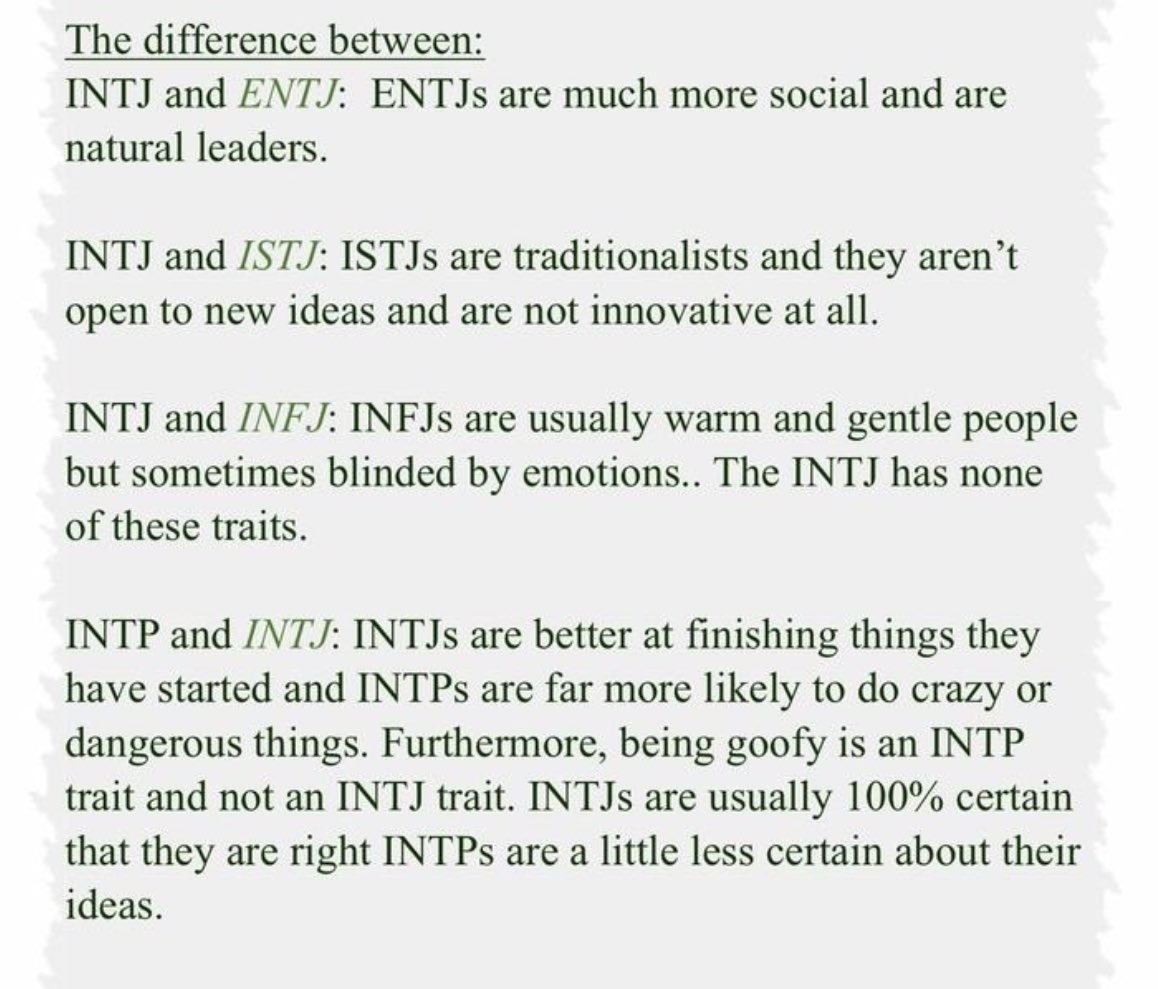
as a non intj, i really disagree with post (haha):


so! here's my revision of it.

- entjs are more likely to state they're going to take action, intjs usually just do w/o needing to make it known
- intjs are usually working toward a goal only they can see, istjs are more "dealing with the issue at hand" types
- if they don't know you well, infjs will still be more likely to talk you into a hole, while an intj won't bother
- both intjs + intps can be equally 'goofy', but an intj's will seem more impulsive while an intp's will occur and then stop suddenly like ur not sure if it really happened. also, intjs are more likely to do things that they are absolutely certain they can do because they have planned for everything that it has to be successful. while an intp may be equally ambitious, they more frequently throw caution to the wind, which on the other hand would freak an intj out.
mbti: (Default)
so, for a very long time and actually up until earlier this year, i'd typed myself first as an infp, then an inxp leaning f, which is remarkable now that i feel a lot more sure that i'm an intp, haha. the only reason i'd begun to consider being an intp is because i made one of my friends take it when we were 13, and then she said she got intp, and i looked at the profile for it and something about it resonated with me.

personally, i know i'm a very empathetic person who feels very strongly. whether it's about values or about people or just my own emotions, i do know what i like, and what i want is important to me. i do act on my emotions.

but at the same time, i also rationalize things out a lot - especially my emotions. i have to internally explain them to myself, work through a pattern and from a source, understand logics from point A to point B and so on. not only that but it's not something that i try to do - i just do it because i need to internally understand what it is, even if myself, as long as it makes sense to me.

and i think that's the thing, at least for me. there's a strong sense of feeling - but beyond that an even stronger foundation of objective logic. i'm very capable of being subjectively personal, but to me, it's not enough if i'm just like "well, that's just me." to me that doesn't make sense - i can't simply trust myself. it feels baseless for me to go "well it's just me" - i have to drive it into the ground, rationally, rather than, say, musing over my thoughts and values and other things that just come from me.

and it's not to say that infps are illogical - because there's no correlation with that - but rather that if i were an infp, i feel like it'd be more of an understanding of myself. when i realized i was an intp it was actually a lot more through understanding mbti itself, because to me, mbti is an objective system (that is, yes, a theory) that i can use as a logical framework and deepen my understanding of it to apply it to myself. it would've been far more infp of me to locate my wants and wonder if i was only considering an intp because i wanted to be (which flitted through my mind but not much of a fixation) or what parts of me were infp vs intp and where i felt more strongly with either. with being an intp, i was more open to the logical possibilities that could result in me being either rather than personally feeling that i was more one than the either.

but all that aside, i think the main reason i still stuck with infp for a long time was because of how emotional i knew i was capable of being. the thing is, while i may both express and feel strongly, that doesn't ultimately mean that i work logically first. the same way an infp may be very logical and analytical, but still prioritize the way they feel about things rather than an objective logic. which is just as valid as the other! the thing with me is that i felt like my Ti - logic - was so "common sense" that i saw it less of as part of my mbti than my Fi, which was so strong.

but it was so much less inherent than my Ti! like i still use it as a shadow function (and on the topic of shadow functions i also know use my Se a lot) but it's just not the instinctive way i approach things. and Ti isn't a fixation or assistant to anything - i just like doing things that make logical sense to me, like puzzles or code or talking about the technicalities of writing! Fi would be more happier just pursuing personal interests because they're personal interests. they could be logical or not, but it's not founded in logic - it's just founded on personal enjoyment.

anyway - i could also get into my inferior functions here, but honestly it made more sense for me to have inferior Fe than Te bc my perception of having a possible inferior Te was actually just externally projected onto me so i thought it was more reliable than actually a pretty efficient Te as long as i was interested LOL. but yeah!

so to everyone else out there who's still debilitating between types - don't worry, it happens to quite a number of people, especially with T-types who know that they feel strongly. i feel like it's a question of T feels more innate than F, or the other way around, regardless of how much you can feel or how analytical you can be.

Profile

mbti: (Default)
i notice the perscriptive

December 2022

S M T W T F S
    123
4567 8910
11121314151617
18192021222324
25262728293031

Syndicate

RSS Atom

Most Popular Tags

Style Credit

Expand Cut Tags

No cut tags
Page generated Jan. 22nd, 2026 06:40 pm
Powered by Dreamwidth Studios