in nuance

Jun. 1st, 2017 08:01 pm
mbti: (Default)
introverts: the modes that get undersold

intps can be incredibly driven and passionate
infps can be intensely knowledgeable and rational

intjs can be incredibly sociable and adaptable
infjs can be intensely bossy and determined

istjs can be incredibly sociable and passionate
isfjs can be intensely detached and rational

istps can be incredibly driven and adaptable
isfps can be intensely knowledgeable and determined

extroverts: not as simple as an outgoing framework

entps can be two sides of silly and serious
enfps can be two sides of distracted and focused

estjs can be two sides of withdrawn and outgoing
esfjs can be two sides of supportive and aggressive

estps can be two sides of relaxed and anxious
esfps can be two sides of down to earth (outspoken) and dreamy (softspoken)

entjs can be two sides of control freaks and cheerleaders
enfjs can be two sides of sensitive and unbreakable

and -isms

Apr. 2nd, 2017 04:21 pm
mbti: (Default)
no, not that kind of ism.

S-doms and T-doms are usually very expressively, visibly realistic, hence a natural need to act immediately in response to it - ExTJ, IxTP, ISxJ, ESxP
N-doms and F-doms are much less visibly focused on reality, as they tend to be wary or afraid that vocalizing an abstract fear into a concrete territory will make it real; if anything they tend appear more idealistic - IxFP, ExFJ, INxJ, ENxP

S-auxiliary and T-auxiliary to F-doms and N-doms are actually much more pessimistic than they appear, hence an innate desire to act immediately in response to it. If healthy and not in the grip this will appear as realistic idealism. - ISFP, ESFJ, INTJ, ENTP
N-auxiliary and F-auxiliary to T-doms and S-doms are actually much more optimistic than they appear, usually trusting in that their initial action (as motivated by their dominant function) to sail an abstract course away from their initial pessimism. If healthy and not in the grip this will appear as idealistic realism. - ENTJ, INTP, ISFJ, ESFP

S/T dom auxiliary and T/S dom auxiliary combine their perceived more pessimistic natures into a view they establish more objectively; that is, realism. They both act in the moment and react in the moment, able to perceive or believe in possibilities but still respond to the nature that is in front of them. If healthy and not in the grip they will have ambitions, moral values, and beliefs that they put a lot of themselves into. - ESTJ, ISTP, ISTJ, ESTP
F/N dom auxiliary and N/F dom auxiliary combine their more hopefully abstract natures into a view they establish not necessarily with optimism, but with idealism. Despite what they see is happening now, and despite what they are doing now, they have an inner faith that they cannot explain but that they believe in. Can be but is not always necessarily a spiritual/theistic faith; but they would be nothing without this inspiration. If healthy and not in the grip, they utilize this very strong core belief to motivate them to act and respond concretely and in the moment. - INFP, ENFJ, INFJ, ENFP
mbti: (Default)
u: what the hell is this post
me: i have a perfectly good explanation for this

Read more... )
mbti: (Default)
ixtj: more highly attuned to their own feelings (which they view subjectively/on an individual basis), prone to be less concerned about Feelings As A Whole depending; if they value feelings it (once again) stems from their value of their own feelings which is then projected onto others; healthily impositional at best but with collateral damage to being controlling/manipulative
ixfj: more highly attuned to Feelings As A Whole, yet disconnected with what they evaluate as their own feelings (which they view more objectively); value emotional effects via rational decisions; cold and emotionless at worst, incredibly sympathetic and seemingly clear-headed at best
mbti: (Default)
- older characters who have a history of being ruthless and bossy leaders (sayid jarrah, dumbledore, iroh) and in the present narrative seem like people who exercise emotions and their caring for people actively are usually matured extjs
- being damaged does not change your mbti type it just changes how you exercise it, e.g. a damaged enfp can be insecure on who they are and mistrustful of others
- while isfjs are commonly labeled as "defenders" (and from my perspective, usually sensitive and anxious characters), when they loop they get extremely closed off, withdrawn/cold, and hyper-judgmental, e.g. petunia from harry potter
- Ne doms (enfp, entp) no matter what aspect of their growth will always feel as comfortable by themselves and alone as they do with people
- in this vein, Si users (notably istjs) actually actively seek to be useful or part of a whole, and have a willingness and can prolong long periods of time interacting with others especially if they are helping with them
mbti: (Default)
dominant function - what you do, your first method of interaction with the world
auxiliary function - what you thrive on, what fascinates you, what you should indulge and what needs to be indulged
tertiary function - what you use as support, subconsciously rely on without question or hesitance, often self-centered and conditional
inferior function - what you need to work on, a target end goal for your first three functions, what you can healthily understand and need in the most superficial ways, and also learn to take action on without letting the dominant function overwhelm it

so...
intp - initially approaches the world through perceived logic with self-contained independence, thrives on new ideas to fulfill or expand the logic, easily works in structure and focus/construction (simultaneous mental/physical) "if it matters", needs to and requires and eventually (if healthily) understands how people work/attention/acceptance (with relation to the dominant function: disregard logic in favor of the consideration of others)
intj - initially approaches the world through specific ideas deep inside their head, thrives on logical execution, easily references their emotions/justifies things to themselves through intrapersonal understanding "if it matters", needs to and requires and eventually (if healthily) interacts with the concrete world and take action (with relation to the dominant function: stop seeing things purely abstractly and internally and instead working with them with practicality & in the real world)
entp - initially approaches the world through a variety of ideas that they're fascinated by, thrives on reaching perceived logical conclusions, easily locates and discusses the emotions of other usually relative to themselves "if they matter" , needs and requires and eventually (if healthily) needs to consistently develop a structure and regular focus (with relation to the dominant function: don't be too caught up in fascination with external possibilities and learn to settle/construct)
infp - initially approaches the world through perceived self-judgment, thrives on new ideas to fulfill or expand the initial personal feelings, easily works in structure and focus/construction (simultaneous mental/physical) "if it matters", needs and requires and eventually (if healthily) needs to effectively carry out logical executions (with relation to the dominant function: instead of just emotionally reacting to everything)
infj - initially approaches the world through specific ideas deep inside their head, thrives on the importance and understanding the generalized emotive effect on others usually relative to themselves, easily works with logic and analysis through impersonal observation "if it matters", needs and requires and eventually (if healthily) interacts with the concrete world and take action (with relation to the dominant function: stop seeing things purely abstractly and internally and instead working with them with practicality & in the real world)
estj - initially approaches the world through logical execution, thrives on systematic method and focus, easily looks for/searches/accesses new ideas to fulfill the self, needs to and requires and eventually (if healthily) needs to self-reflect and understand and admit emotions and their intrapersonal relationship (with relation to the dominant function: to take time away from execution to fully see and understand the self in a rounded way and impact on others)
esfj - initially approaches the world in awareness of others/how people work and external interpersonality (even if not interactive or technically surrounded by others), thrives on systematic methods and focus (in order to help, or execute, but of course in general), easily accesses/searches for/new ideas to fulfill the self, needs to and requires and eventually (if healthily) needs to look at things analytically (with relation to the dominant function: to disregard the initial sympathy to see things in subjectivity/logical conclusions)
enfj - initially approaches the world in awareness of/how people work and external personality (even if not interactive or technically surrounded by others), thrives on internal understanding and establishing specific ideas inside their head, easily interacts and participates with the external world and taking action "if it matters", needs to and requires and eventually (if healthily) needs to look at things analytically (with relation to the dominant function: to disregard the initial sympathy to see things in subjectivity/logical conclusions)
esfp - initially approaches the world to take action and participate and work, thrives on personal reaction and perceived self-judgment/reflection and intrapersonal understanding, easily accesses the ability to logically execute (ideas, ambitions, etc.) "if it matters" to them, needs to and requires and eventually (if healthily) establishes specific ideas inside their head with internal & mental abstractions (with relation to the dominant function: consequences of their actions, goals to work for, etc.)
istj - initially approaches the world through an internal understanding of construction and necessity and present action in the most effective ways, thrives on logical execution, easily references their emotions/justifies things to themselves through intrapersonal understanding "if it matters", needs to and requires and eventually (if healthily) search for and be fascinated at a new/variety of ideas (with relation to the dominant function: to be less fixed on the pre-established mental and practical structure and instead invite new seemingly implausible/useless/ineffective possibilities into their life)
isfj - initially approaches the world through an internal understanding of construction and necessity and present action in the most effective ways, thrives on the importance and understanding the generalized emotive effect on others usually relative to themselves, easily works with logic and analysis through impersonal self-justification "if it matters", needs to and requires and eventually (if healthily) search for and be fascinated at a new/variety of ideas (with relation to the dominant function: to be less fixed on the pre-established mental and practical structure and instead invite new seemingly implausible/useless/ineffective possibilities into their life)
istp - initially approaches the world through perceived logic with self-contained independence, thrives on taking action and participating and work in the concrete world, easily understands things internally and mentally with specific ideas inside their head "if it matters," needs to and requires and eventually (if healthily) understands how people work/attention/acceptance (with relation to the dominant function: disregard logic in favor of the consideration of others)
estp - initially approaches the world to take action and participate and work, thrives on reaching perceived logical conclusions, easily locates and discusses the emotions of other usually relative to themselves "if they matter", needs to and requires and eventually (if healthily) establishes specific ideas inside their head with internal & mental abstractions (with relation to the dominant function: consequences of their actions, goals to work for, etc.)

i'm lazy so the rest of these patterns can be appropriately applied to enfj, enfp, and entj
mbti: (Default)
isfp - the most intuitive of the sensors [commonly said by others]
entj - the most sensory of the intuitives
infj - the most thinky of the feelers
estp - the most feely of the thinkers
intp - the most judgy of the perceivers, but only with a thin line between istp (hence why people can mistype intp chars as intjs, especially if the character is Ti-Si looping))
esfj - the most perceiving of the judgers, but only with a thin line between enfj (hence why a lot of exfjs mistype as enfps)
enfp - the most introverted of the extroverts; that is, feels as comfortable with others as they feel alone and can stand an equal amount of time in both aspects
istj - the most extroverted of the introverts; that is, actively want to and enjoy being useful and part of something bigger than them

also i really like this, check it out

anyway

Feb. 16th, 2017 10:14 am
mbti: (Default)
inxjs rarely type correctly on the first try

either mistyped with their F/T, or as infps (infjs), or as istjs (intjs)

infps/istjs also often mistype as their inxj counterparts
usually because they think higher of their tert Si (infp) or are in a Si-Fi loop with their perception of their intuition
mbti: (Default)
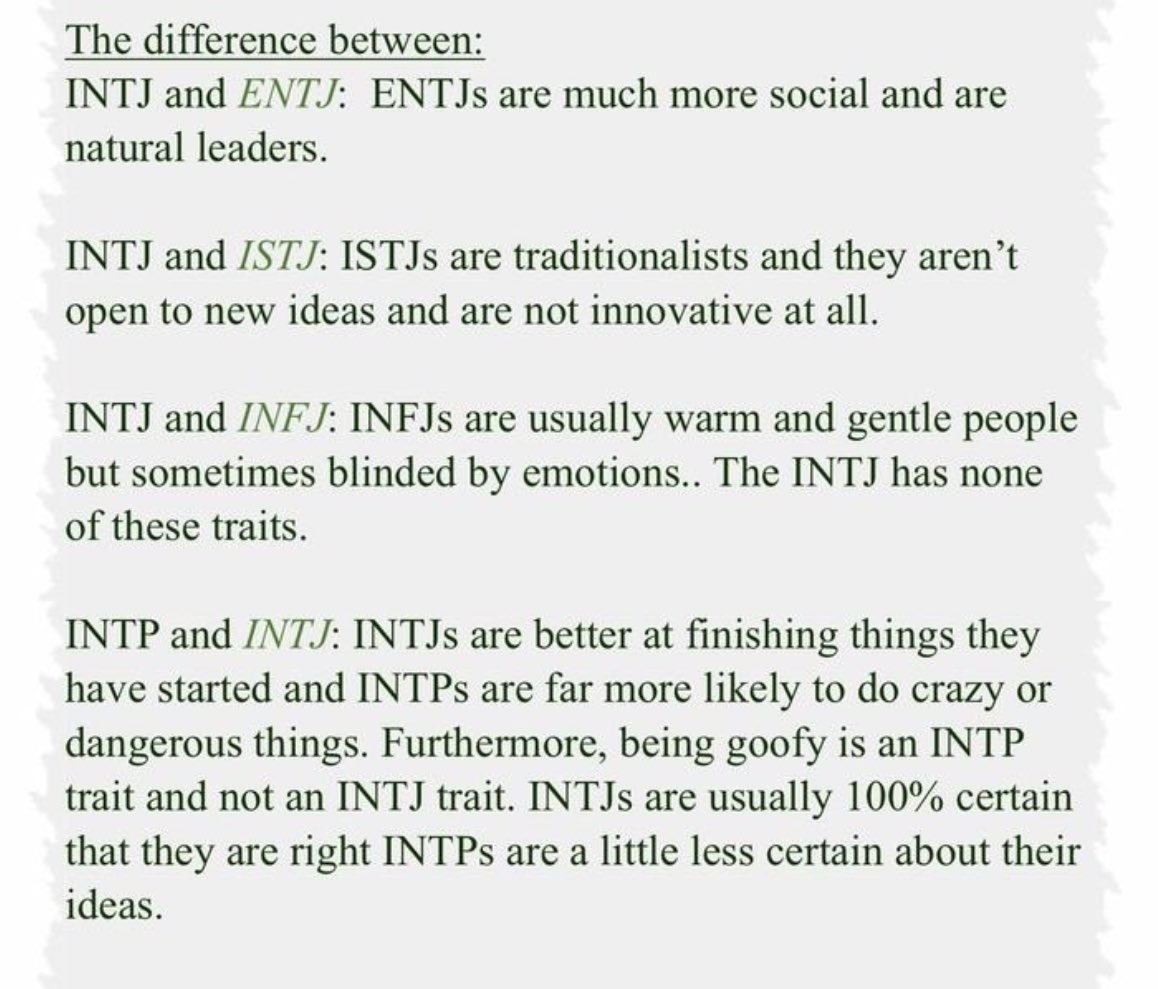
as a non intj, i really disagree with post (haha):


so! here's my revision of it.

- entjs are more likely to state they're going to take action, intjs usually just do w/o needing to make it known
- intjs are usually working toward a goal only they can see, istjs are more "dealing with the issue at hand" types
- if they don't know you well, infjs will still be more likely to talk you into a hole, while an intj won't bother
- both intjs + intps can be equally 'goofy', but an intj's will seem more impulsive while an intp's will occur and then stop suddenly like ur not sure if it really happened. also, intjs are more likely to do things that they are absolutely certain they can do because they have planned for everything that it has to be successful. while an intp may be equally ambitious, they more frequently throw caution to the wind, which on the other hand would freak an intj out.
mbti: (Default)
I don't think there's any debate with this since Kageyama sort of fits the ISTJ personality mold; at the same time I don't like attributing to the idea that fitting a mold indicates that the mold is correct. So I'm going to break this down as "proof" to why Kageyama is an ISTJ.

Disclaimer: The last Haikyuu!! chapter I read was probably like 207, so I'm very behind with the manga.

Read more... )

Profile

mbti: (Default)
i notice the perscriptive

December 2022

S M T W T F S
    123
4567 8910
11121314151617
18192021222324
25262728293031

Syndicate

RSS Atom

Most Popular Tags

Style Credit

Expand Cut Tags

No cut tags
Page generated Jan. 22nd, 2026 12:41 pm
Powered by Dreamwidth Studios